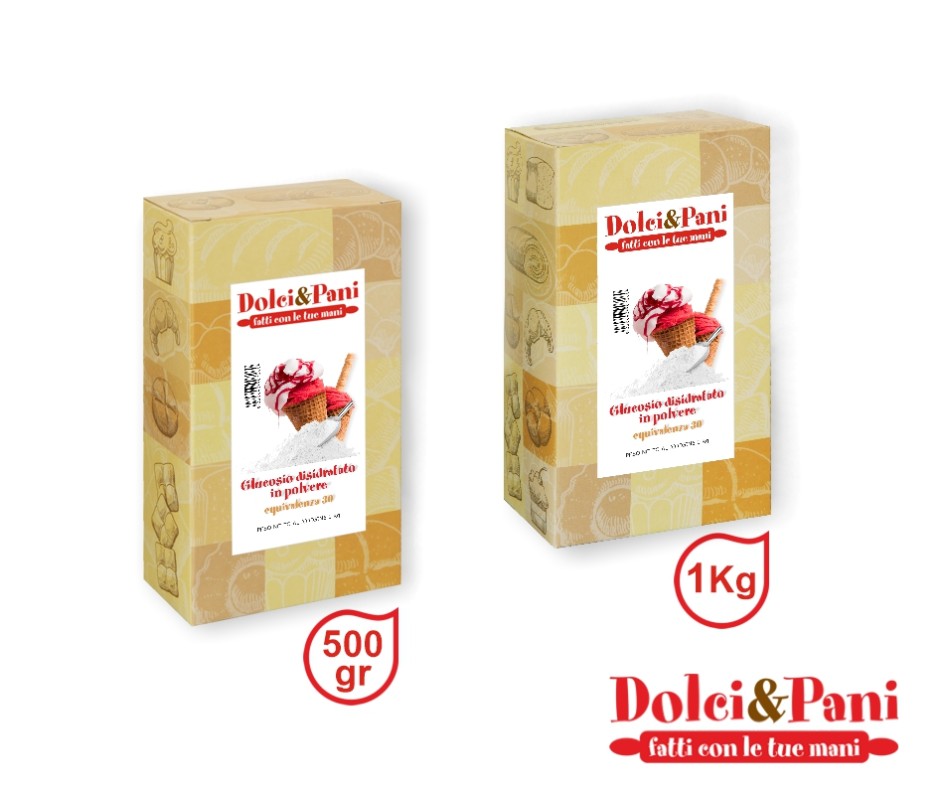
Dehydrated Glucose Powder (DE 29-30)
- Stock: In Stock
- Reward Points: 10
- Code: DP726
- Weight standard packaging: 1.00kg
- V.A.T. applied: 10%
Available Options
Glucose is a simple sugar (monosaccharide) and represents one of the main sources of energy for our body. Glucose is essential for the functioning of many tissues, particularly the brain, which uses glucose as its primary source of energy.
It is naturally found in many foods, such as fruit and honey, and is also present in complex carbohydrates like bread, pasta, rice, potatoes, and cereals, which are broken down into glucose during digestion. It has a high glycemic index and a lower sweetness compared to sucrose (table sugar).
The 29-30 equivalence of the glucose offered indicates the percentage of its amount of reducing sugars compared to pure glucose (defined as 100). The lower the equivalence, the higher its viscosity and water retention characteristics. As the equivalence increases, these properties decrease while the degree of sweetness and hygroscopicity increase. A higher equivalence also results in a lower freezing point of the mass in which it is dispersed (such as in ice creams).
In baked goods, glucose facilitates leavening and preservation while adding color. In ice cream making, it prevents freezing, improves creaminess and texture, and enhances flavor.
Since our catalog also includes 40-45 glucose, we remind those interested in ice cream making that:
- Glucose 29-30 is less sweet than 40-45 and has a lower antifreeze effect. It is used when a less sweet, firmer ice cream texture is desired.
- Glucose 40-45 is sweeter and gives more softness to ice cream due to a greater antifreeze effect, thus better preventing crystallization.
DOSAGE: according to the recipe.
P.S. In common language, glucose is also called "dextrose." The two terms can be considered equivalent, although a technical clarification must be made.
Glucose is a monosaccharide, a type of simple sugar with the chemical formula C₆H₁₂O₆.
Dextrose specifically refers to the D-anomeric form of glucose (dextrorotatory), meaning that this form of glucose rotates polarized light to the right (hence the prefix "dextro-").
| Composition | |
| Characteristic Ingredients | |
| Allergins | |
| Cross Contamination | |
| Nutritional Facts (Serving Size 100 g) | |
| Energy | |
| General characteristc | |
| Available packaging | |
| Recycling collection | |